Why You Wake Up Stiff Every Morning (And What Your Joints Actually Need)
I’ve spent most of the last month at my desk sequencing thirty classes for a new beginner program, and it did something to my thinking I wasn’t expecting.
Some context, in case this is the first thing of mine you’ve read. I’m a yoga therapist with a master’s degree in yoga therapy, and I work almost entirely with adults over 50. Most of my students come to me stiff, cautious, and a little unsure whether yoga is even for them anymore. Everything I teach is built around five things I call the pillars of movement longevity: joint-freeing mobility, strength, balance, posture, and flexibility.
Those five aren’t a marketing framework. They’re what I think a body actually needs to keep working well for decades, and I sequence every class I teach around them.
So when I sat down to build the beginner program, I knew from the start it would be built on those five pillars. That part was never a question.
What surprised me was how much clearer I got about each one.
When you have to decide what actually goes into thirty classes, you can’t stay general. You have to choose, over and over, for weeks. And somewhere in that process I got very specific about what I truly believe is the most important part of each pillar, and why.
That’s what this series is. Five pillars, five posts and episodes, and the clarity I came out of that month with.
Let’s jump right in with joint-freeing mobility.
This post comes from this week’s episode of Yoga for Longevity, my podcast about moving with more ease and supporting healthy, vibrant aging. You can listen to the full episode below. And if you’d like to be first to hear about Lifelong Yoga Foundations, my new beginner program launching at the end of September, you can join the interest list here.
What Joint-Freeing Mobility Actually Means
The name matters here, and the important word is not mobility. It’s joint-freeing.
Plenty of movement improves flexibility. Fewer things are designed around what a joint specifically needs, which is to travel through every direction it was built to travel through, regularly, without force.
That’s the whole goal of this pillar. Keeping your joints moving comfortably and confidently.
Not deeper stretches. Not more range than you had last year. Just joints that still have access to their own directions.
Why Stiff Joints Become So Common After 60
“I wake up so stiff every morning.”
If I had to guess what a new student is going to tell me in the first five minutes, that’s it. Not pain, usually. Stiffness. That sense of having to negotiate with your body before it agrees to cooperate.
Right behind it comes arthritis. I work with so many people with arthritis, and so many people who have had a knee or a hip replaced. It comes up constantly, in classes, in emails, in the comments on my videos.
And it should, because it’s common. Among women between 65 and 74, close to half have been diagnosed with some form of arthritis, according to CDC data from the National Health Interview Survey. After 75, it climbs to nearly sixty percent.
So if that’s you, you’re not in some small unlucky group. You’re in the majority of women your age.
But common and unchangeable are two different things, and people tend to answer both questions at the same time. Someone gets a diagnosis, and the stiffness they feel every morning gets filed under it permanently. Case closed.
The diagnosis is one thing. How your joints feel day to day is a separate question, and that one has more room in it than most people assume.

Why Your Joints Feel Stiffest in the Morning
There’s a real physiological reason for that first-thing-in-the-morning feeling, and once you know it, the fix becomes obvious.
Your joints are lubricated by synovial fluid. It does two jobs: it reduces friction so the joint surfaces glide, and it carries nutrients to your cartilage.
That second job matters more than people realize, because cartilage has no direct blood supply. Most of the tissue in your body gets fed by blood vessels. Cartilage doesn’t work that way. It depends on synovial fluid for nutrient exchange, which means movement is one of the primary ways your cartilage gets fed.
Read that again, because it’s the piece almost nobody has been told. Your cartilage is not passively wearing down on a timeline you can’t influence. It’s tissue that gets nourished, and the nourishment arrives through movement.
Here’s the part that explains your mornings. Synovial fluid is thick and gel-like when it has been sitting still. It thins out when you move. Some people call it morning gel.
So when you wake up stiff, that fluid has been at rest all night. Nothing went wrong while you were sleeping. Your joints have simply been still for eight hours.
Which means waiting for the stiffness to pass is not the answer. Movement is literally what thins the fluid back out.
Motion is lotion. I’ve said that in classes for years, and it turns out to be more literal than I realized.
Why Gentle Joint Movement Works Better Than It Looks
A lot of my students come to me used to pushing themselves. They’re used to more intense exercise, or they carry the belief that intense is what it takes to actually change something in their body.
I understand where that comes from. Most of us were raised on the idea that if it doesn’t hurt, it isn’t working. That belief has cost a lot of people a lot of years.
So when we start class with joint-freeing movement, they’re often taken aback. It seems so small and simple, like it can’t be doing much.
It’s doing so much.
There’s more happening than I can fit into one post, but here are three of the biggest benefits. Not one of them requires you to push.
Your cartilage gets fed. That’s the synovial fluid piece above. It doesn’t take force to circulate. It takes movement.
Your joints get variety. A joint that only ever moves forward and back is only ever being nourished in that one range. Most of us cycle through the same handful of patterns every day: sit, stand, walk, reach forward, repeat. Then we repeat that for thirty years. The joint isn’t the problem. The repetition is.
You build body awareness. Your joints contain sensors that tell your brain where your body is in space. That sense declines with age, and it responds to being used. You can’t feel much when you’re pushing hard. You can feel a great deal when you’re moving slowly through a small range and paying attention.
That last one carries forward into everything else. Into balance work, into strength, into how you catch yourself when you trip on the sidewalk.

Why This Pillar Comes First
Joint-freeing mobility is the first pillar because the other four are harder to build without it.
Strength, balance, posture, flexibility. Every one of them asks a joint to do something. If the joint can’t get there, you’re working around a limitation instead of through it.
If your ankle can’t move well, your balance work is limited before you start. If your hips can’t open, your standing poses have nowhere to go. If your upper back is stuck, your posture work is fighting a structure that won’t cooperate.
That’s the order in my classes, and it’s the order in the program.

Where We Lose Joint Mobility as We Age
We tend to lose mobility in specific places as we age, especially when we stop moving those joints regularly. Three areas come up again and again.
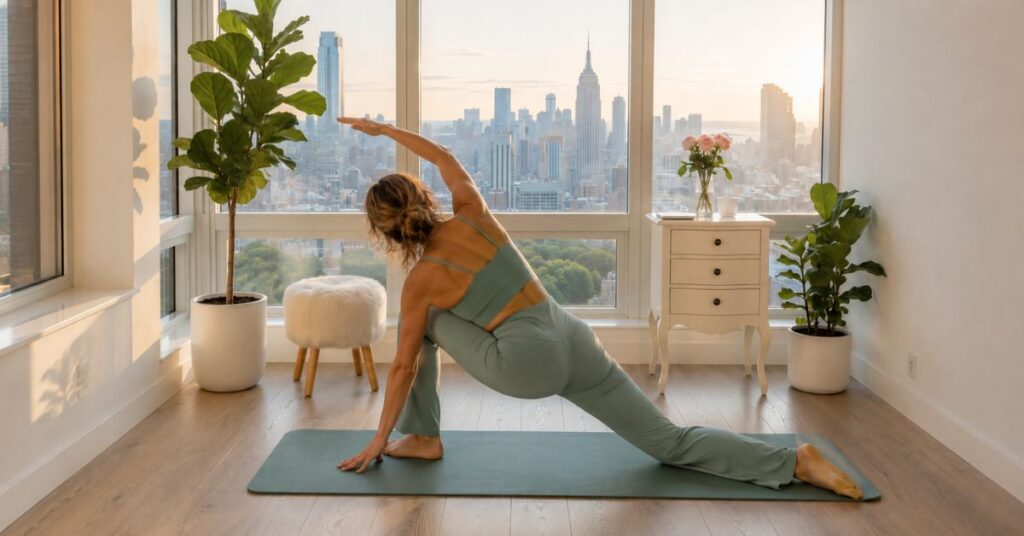
Hips. Research comparing adults in their twenties and thirties to adults 60 to 74 found hip extension range dropping around 20%. Reduced hip mobility has been linked to slower walking speed and a shorter stride. And when the hips stop contributing, the low back usually picks up the slack.
Thoracic spine. The mid and upper back is the area we spend our lives rounding forward. When it stops moving well, it changes how you breathe, because the ribs can’t expand the way they should. It changes your shoulders too, since reaching overhead gets harder when your upper back can’t extend. It also feeds directly into the rounded upper back posture I talk about so often.
Ankles. There’s a movement at the ankle called dorsiflexion. In plain terms, it’s the shin traveling forward over a planted foot. That happens every step you take, every stair you go down, every time you stand up from a chair. Adults lose ankle dorsiflexion over time, and reduced ankle mobility has been associated with changes in balance and gait.
The ankle one is especially worth paying attention to, because when the ankle can’t move, everything above it compensates. The knee takes on more. The hip takes on more. The low back takes on more. The stride shortens. Balance gets less reliable on uneven ground.
Nobody wakes up thinking their ankles feel stiff. They think, I’m not as steady as I used to be.

How to Start Moving Your Joints Every Day
More than anything else, whatever kind of movement you’re doing, start with a few minutes of moving your joints.
It doesn’t matter if you’re heading into a yoga class, out for a walk, or into the garden for the afternoon. Give your joints a little movement first.
That’s how I teach nearly every class. Even the balance classes. Even the strength classes. We start there, and it isn’t a warm-up in the usual sense. A warm-up is something you get through. This is preparation. We’re helping the joints move well before asking the body to do more.
And when you do it, explore the movement instead of forcing it. Take a joint through the range it has available today and see what’s there. Not where it was ten years ago. Not where you’d like it to be by Christmas. Today.
Some days there’s more range. Some days there’s less. Both are fine, and neither one means anything about you.
If you did nothing else from everything I teach, I’d want you to keep moving your joints.
Take care of your joints.

What I Mean When I Say Yoga
You can probably tell by now that there’s more going into how I sequence a class than a list of classic yoga poses. So let me say something about the word itself, because I use it a lot around here.
Yoga itself is not the poses. It’s a way of living and being.
The poses themselves are not the magical thing. I actually believe that every movement or exercise can be yoga if you do it with breath and presence.
And to be honest, some of the traditional yoga postures just aren’t that functional for aging bodies. I’ve spent years studying how the body moves, and years working with aging bodies specifically. All of that comes into what I teach. It doesn’t make it not yoga.
I do still teach yoga poses. I want to be clear about that, because I’m not running some pose-free operation over here. I absolutely still teach poses.
But it’s not going to look like your typical vinyasa class, because I know too much now. I know too much about how the body moves to sequence a class the way I would have ten years ago.
So when we spend the first part of class moving your ankles and your hips and your spine through all their directions, that is the practice. Breath, attention, and moving your body in the ways it actually needs.
Yoga is the vehicle, not the destination. It’s just the vehicle I use to teach this.
P.S. This is the first of five episodes going behind the scenes of how I think about movement, one pillar at a time. Next week is Strength for Life. If this way of thinking resonates, I’d love to have you on the interest list for Lifelong Yoga Foundations.