Flexibility for Life: It’s Not About Being Bendy
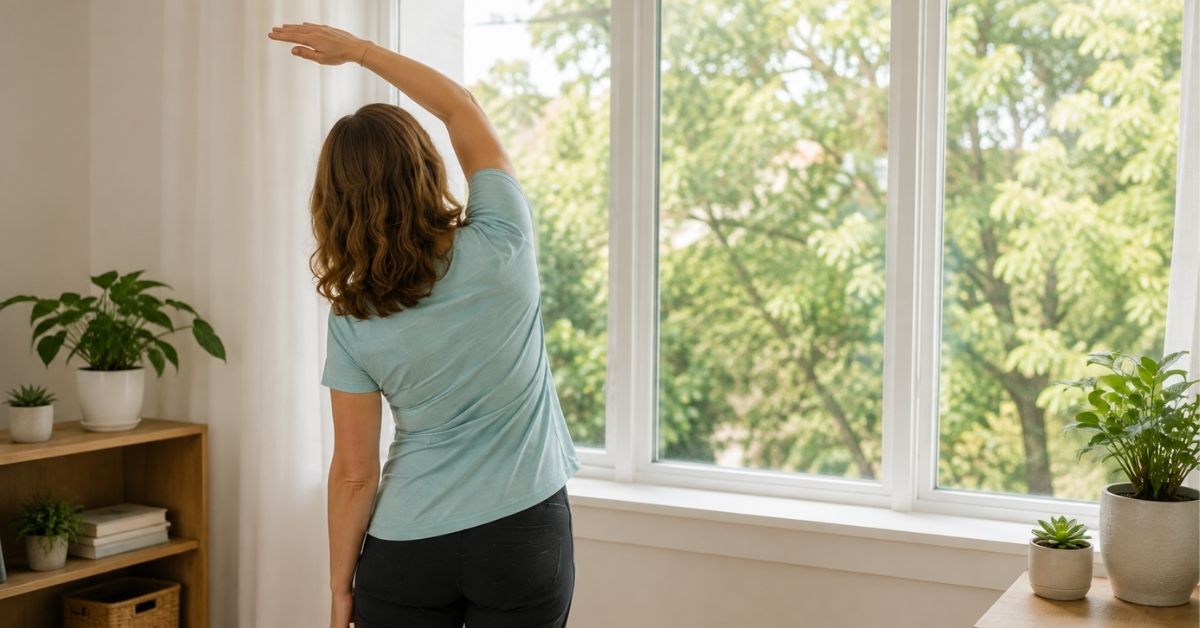
When you feel tight, it seems logical to stretch.
And if a little stretching is good, going a little deeper must be better… right?
Not necessarily.
One of the biggest things I want my yoga students to understand about flexibility is that it isn’t something you have to force. In fact, continually pulling harder or trying to reach your maximum range can create exactly the kind of tension we’re trying to let go of.
For healthy aging, the goal isn’t extreme flexibility. We want enough comfortable, usable range of motion to move freely through yoga and everyday life.
And getting there may have less to do with how far you can pull yourself into a stretch and more to do with giving your body the right conditions to gradually adapt.
Prefer to listen? This article is based on Episode 58 of Yoga for Longevity, where I explore Flexibility & Release, the final pillar in my Five Pillars of Movement Longevity.
Why Flexibility Matters as We Get Older
You do not need to put your leg behind your head.
I feel like we should establish that right away.
What we do want is enough flexibility that our muscles and connective tissues aren’t unnecessarily restricting the movement available to us.
Think about what that means outside of yoga.
You need comfortable range of motion to reach overhead, take a full stride when you walk, move your shoulders freely, bend and reach, and transition between positions without feeling unnecessarily restricted.
This is also where flexibility and mobility overlap.
Mobility refers to our ability to actively move a joint through its available range. Flexibility refers more specifically to the ability of muscles and other soft tissues to lengthen and allow movement.
They’re related, and we need both.
That’s why two of my Five Pillars of Movement Longevity are Joint-Freeing Mobility and Flexibility & Release. They support one another, but I don’t approach them in exactly the same way.

Feeling Tight Doesn’t Necessarily Mean Your Muscles Are Too Short
We often interpret tightness very literally.
“My hamstrings feel tight, so my hamstrings must be too short.”
Then the solution seems obvious: stretch them until they’re longer.
But the sensation of tightness is more complicated than that.
There can be many factors involved, including muscle tone, stiffness, sensation, structural limitations, and neural factors. That’s a rabbit hole worthy of its own article.
For now, the useful takeaway is this:
Feeling tight doesn’t automatically mean a muscle is physically too short and needs to be stretched longer.
Research on static stretching helps illustrate why.
Regular static stretching can improve range of motion. But research suggests those improvements may involve multiple adaptations, including decreased tissue stiffness and increased stretch tolerance, meaning you’re able to comfortably tolerate more of the sensation associated with a stretch.
One systematic review found both decreased stiffness and increased stretch tolerance following regular static stretching, while finding no significant change in muscle fascicle length.
In other words, becoming more flexible is more complicated than simply making a short muscle longer.
And that changes how we might approach stretching.
A Better Stretch Doesn’t Have to Be a Deeper Stretch
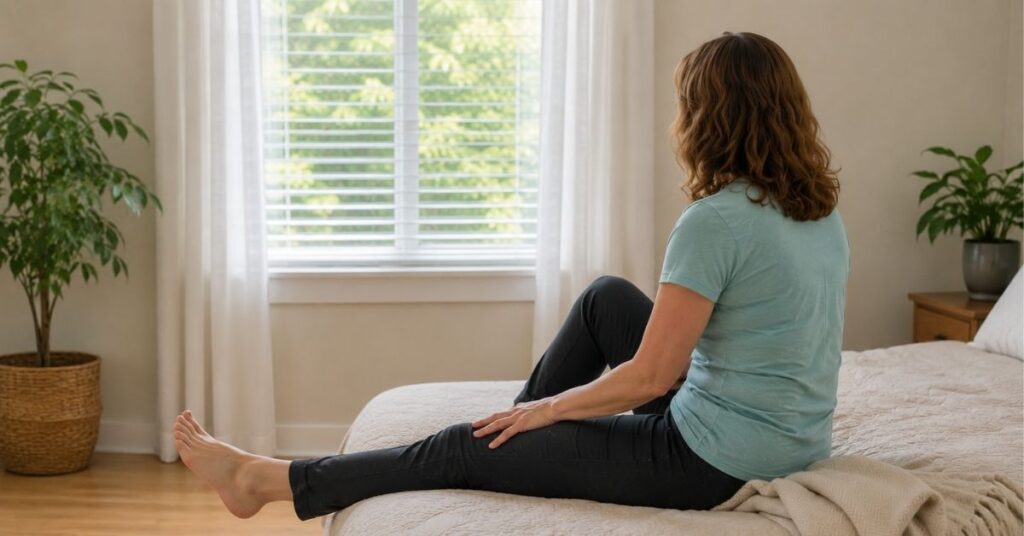
Have you ever watched someone stretch and seen this happen?
They’re pulling themselves as far as possible into the position. Their jaw is clenched. Their shoulders are tense. Their hands are gripping. Maybe their toes are curling.
And they’re barely breathing.
Suddenly we’re trying to create flexibility while producing a whole lot of tension around it.
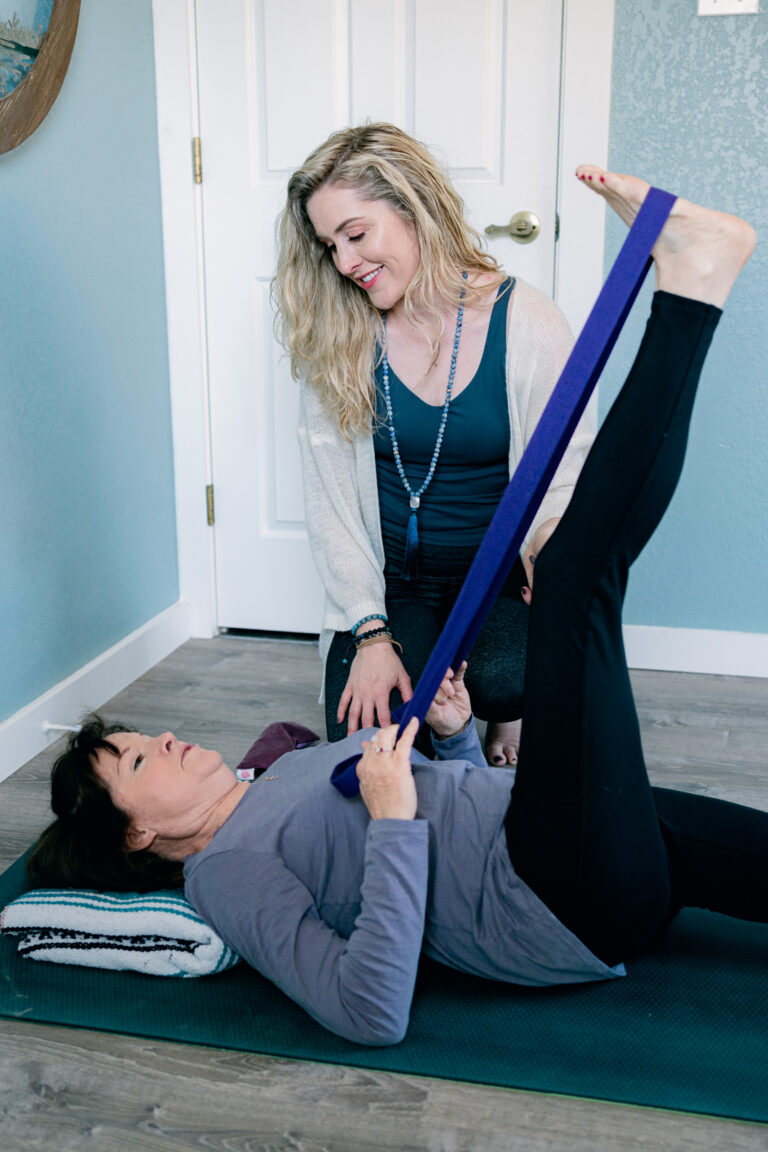
Instead, I encourage my students to find an appropriate stretch sensation with enough room to stay, breathe, notice, and soften.
I might ask:
Where can you soften?
Are you gripping somewhere you don’t need to?
Can your jaw relax?
Can your shoulders soften?
Can your hands soften?
And instead of pulling yourself farther, what happens if you simply breathe and give your body a little time?
This doesn’t mean you should never feel a stretch. You should.
But there’s a difference between a clear, manageable stretch sensation and fighting your body to get another inch of range.
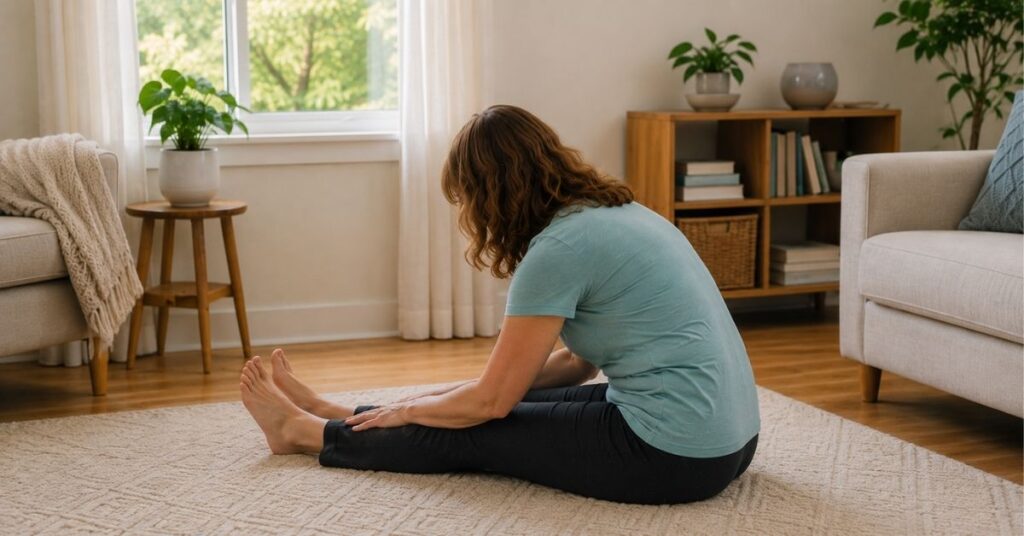
Longer Holds Don’t Have to Mean Harder Holds
I use plenty of dynamic movement in yoga.
In fact, I generally begin my Lifelong Yoga practices with Joint-Freeing Mobility. We’re moving the joints through comfortable ranges, warming up, exploring what’s available that day, and preparing the body for what’s coming next.
I tend to save longer-held stretches for later.
By then, you’ve moved. You’ve generated some warmth. You’ve challenged your strength and balance. Your body has also given you quite a bit of information about how it’s feeling that day.
Now we begin reducing effort.
And although you’ll hear plenty of very specific stretching prescriptions online, there isn’t one scientifically established magic number of seconds that every person needs to hold every stretch.
What we do know is that regular static stretching can improve range of motion.
So when I give a stretch more time, the goal isn’t to spend that time pulling farther and farther.
It’s to settle.
Breathe.
Notice.
Soften unnecessary effort.
And give the body some time.
Longer doesn’t have to mean deeper.
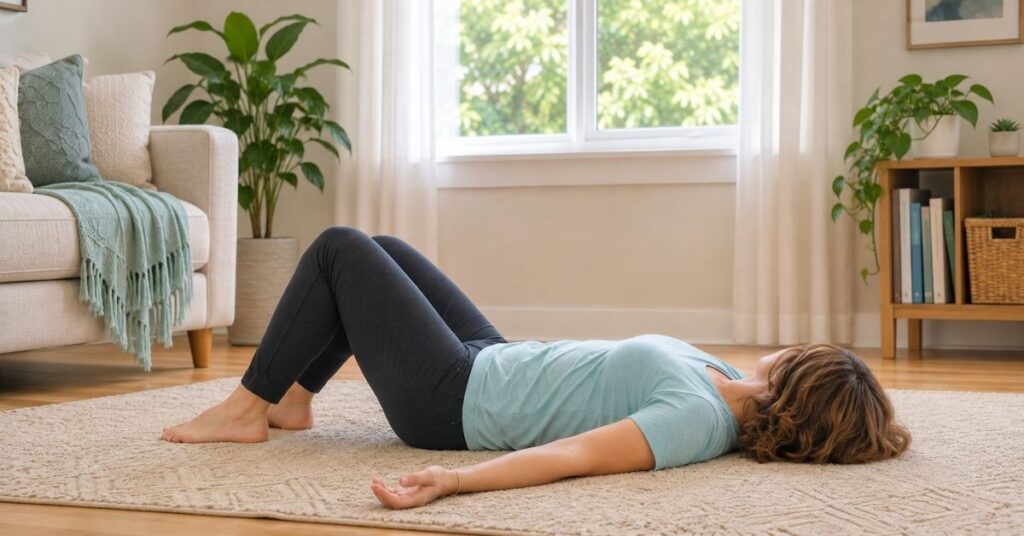
The “Release” Part of Flexibility & Release
There’s a reason I don’t simply call this pillar Flexibility.
It’s Flexibility & Release.
Because we’re not just going:
Hamstrings. Hips. Done.
We’re also learning to recognize unnecessary muscular tension and become more aware of what we’re doing with the rest of the body while we stretch.
One of my favorite questions to ask during a longer-held pose is:
What can soften without changing the pose?
Maybe absolutely nothing about the shape of your pose changes.
Your knees don’t move closer to the floor. Your forward fold doesn’t get deeper. Your hands don’t reach another inch.
But your jaw unclenches.
Your shoulders drop.
Your grip softens.
Your breathing becomes easier.
Can that count as progress, too?
I think it can.
And this is one of the places where yoga becomes more than simply stretching muscles. We’re practicing attention, body awareness, and our ability to notice effort and consciously let go of some of it.

How Breath Can Help You Explore Release
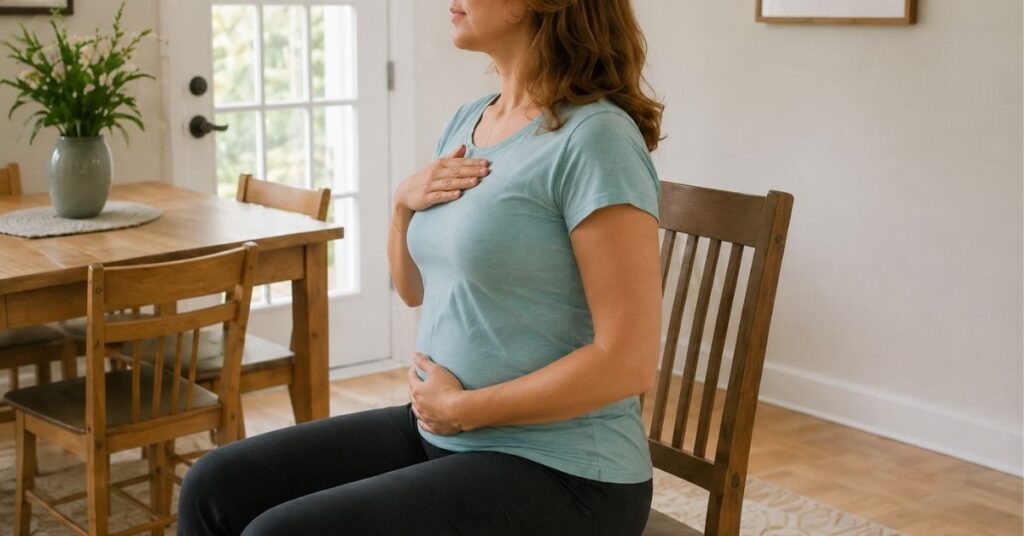
Breath is one of the tools we can use to create those conditions.
Research suggests that slow breathing can influence autonomic regulation, including measures of heart-rate variability associated with parasympathetic activity.
In my teaching, I sometimes invite students to gently lengthen the exhale during the Flexibility & Release portion of practice.
That might look like:
Inhale for 4 counts, exhale for 6.
Or inhale for 3, exhale for 5.
There’s nothing magical about those particular numbers. Research comparing longer-exhale breathing with equal inhale-to-exhale ratios is mixed.
The bigger idea is much simpler:
Slow the breath. Keep it comfortable. And if it feels good, allow the exhale to become a little longer.
As physical effort decreases and the breath slows, we’re also beginning the transition from the active part of practice toward relaxation and eventually Savasana.
Try This the Next Time You Stretch
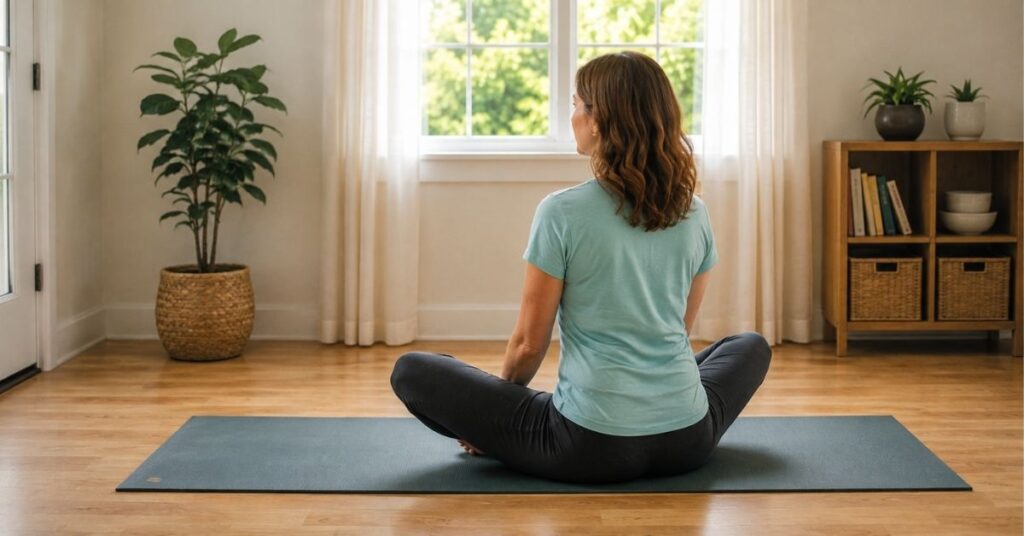
You can explore this idea in Butterfly Pose, or Baddha Konasana.
Bring the soles of your feet together and allow your knees to open comfortably to the sides. Find the first place where you notice a clear but manageable stretch.
Don’t try to push your knees toward the floor.
Don’t go to your maximum.
Instead, take a comfortable inhale through your nose and let your exhale become just a little longer.
Then resist the temptation to use that exhale to push deeper.
Ask yourself:
Can my jaw soften?
Can my shoulders soften?
Can my hands soften?
Am I gripping anywhere I don’t need to?
Can I let the weight of my body settle a little more?
Stay for several comfortable breaths.
If your body naturally gives you a little more room, you can explore it.
But don’t manufacture it.
Use the exhale not as a command to go farther, but as an opportunity to notice what your body might be willing to release.
Flexibility Is About Freedom, Not Extremes
Flexibility is only one part of moving well as we age.
In Lifelong Yoga, I bring together five capacities I call the Five Pillars of Movement Longevity: Joint-Freeing Mobility, Strength for Life, Balance for Fall Prevention, Healthy Posture, and Flexibility & Release.
They aren’t five separate boxes.
Strength requires mobility. Balance requires strength. Posture involves mobility and strength. Flexibility gives us room to express movement. And breath and awareness weave through all five.
Because ultimately, we’re not doing yoga to become better at yoga.
We’re doing it to live better.
So you don’t need to see how far you can pull your body today.
Give it some time. Breathe. Pay attention.
You might discover that getting more from a stretch doesn’t always require going farther.
Want to put all of these pieces together in your own practice? Lifelong Yoga Online gives you structured, accessible yoga practices designed around mobility, strength, balance, posture, flexibility, and body awareness, with most classes around 15–30 minutes. You can start with a 7-day free trial.