Posture Changes How You Breathe, Move, and Feel

Posture is the thing most people never get around to working on, and I understand why. It sounds like a lecture. Stand up straight, shoulders back. Most of us have been hearing some version of that since we were twelve.
But posture is not a cosmetic issue. Where your body sits in space affects your breathing, your neck, your shoulders, your back, your balance, and how much effort it takes to do ordinary things. That is a lot of your day, and it is more changeable than almost anyone believes.
This post is adapted from Yoga for Longevity, my podcast where I share therapeutic yoga tools for healthy aging. I’m Mikah Horn, yoga therapist and founder of Lifelong Yoga Online, a membership designed especially for adults 50+. If you’re looking for a way to put the things you learn in this episode into practice, you can explore it free for 7 days, with gentle classes for joint health, healthy hips, posture, and more.
What Your Posture Is Doing to Your Breathing
Try this before you read any further. Slouch all the way down, round the front of your chest forward, and take the biggest breath you can. Then sit up, get long through your spine, and take another one.
You just felt it. When the front of your chest rounds forward, your ribs cannot expand the way they are built to and your diaphragm does not have the room it needs. And that difference is happening on every breath you take, all day, about twenty thousand of them.
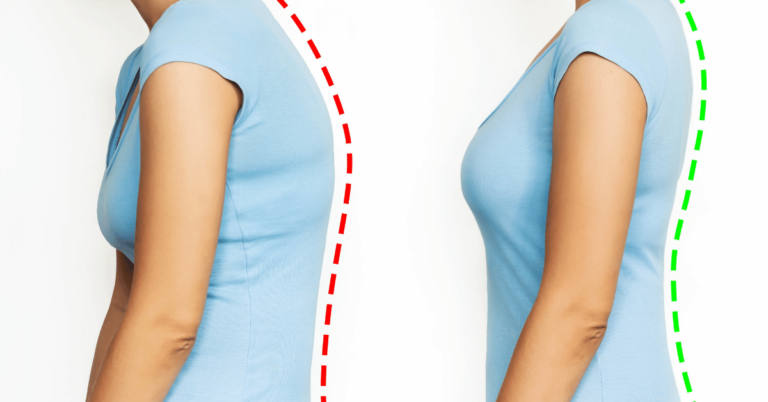
This is not just a sensation. Older adults with a pronounced forward curve in the upper back have measurably less lung capacity and more shortness of breath than people the same age without it.

Why Posture and Balance Are the Same Problem
If you read what I wrote about balance a few weeks ago, this next part will sound familiar.
When your upper body drifts forward, your center of gravity moves forward with it. So you can be doing all the balance work in the world, but you are starting from a position where your weight is already out ahead of your feet.
And that is exactly what researchers find in people with a pronounced curve. More sway, slower walking, and more falls. Your posture is the starting position for your balance, which is why I do not treat these as separate things.

How Common a Rounded Upper Back Really Is
When that curve in the upper back becomes pronounced it has a clinical name, hyperkyphosis, and somewhere between twenty and forty percent of older adults have it. That is also where most of the research has been done, so that is what I am drawing from here.
Some of it is structural. Discs change with age, connective tissue loses its elasticity, and for some people there are vertebral fractures involved. But only about a third of people with a severe curve have a confirmed fracture, which means that for most people, most of it is muscle, soft tissue, and habit. That is the part you have a say in.
A study back in 2009 took a hundred and eighteen adults over sixty who already had a pronounced forward curve and put half of them in Hatha yoga three days a week for twenty-four weeks. Their curve decreased. Not dramatically, about four to five percent, but the researchers’ own word for it was remediable.

Why Pulling Your Shoulders Back Has Never Worked
Here is what happens when you try it. You pull your shoulders back, you grip between your shoulder blades, you hold your breath a little, and you stay there until it gets uncomfortable, which takes about ninety seconds. Then you let it go.
That is tension, not posture, and nobody can hold tension all day.
Posture is something you move through. It is your body’s ability to move well through a lot of different positions and then come back to a comfortable, efficient place when you are done.
No position is inherently bad. Slouching is not bad. Looking down at your phone is not bad. The problem is staying in one of them for hours, every day, for years. Your body is extremely good at becoming whatever you ask it to be repeatedly, so tissues shorten where you are closed and muscles weaken where nothing is asking anything of them.
That is adaptation. Your body did exactly what it is supposed to do based on the information you gave it.

The Invisible Box Your Shoulders Live In
So look at the information we are giving it. You sit. You walk forward. You drive with your arms out in front of you. You work at a computer. You look down at your phone. You reach forward to load the dishwasher and chop vegetables and push a cart.
Every one of those happens in the same plane of movement, forward and back. There are three planes your body can move in, and most of us live almost entirely in one of them. Almost everything we do is in front of us, and low. Nothing overhead. Nothing behind us. Very little rotation.
Pete Egoscue described this in his book Pain Free better than I can. He says our whole world of motion has been squeezed into an invisible box, about three feet by four feet, hanging in midair directly in front of us, from roughly your mid thigh up to your armpits. We reach into it to answer the phone and unlock the car, and we do almost nothing outside of it.
Your shoulder is the most mobile joint in your body. It can go overhead, behind you, across you, out to the side, and rotate in both directions. Most of us use a fraction of that, over and over, for decades. And a joint that never goes somewhere stops being able to go there.

How to Improve Your Posture After 50
Everything I teach for posture does one of three jobs.
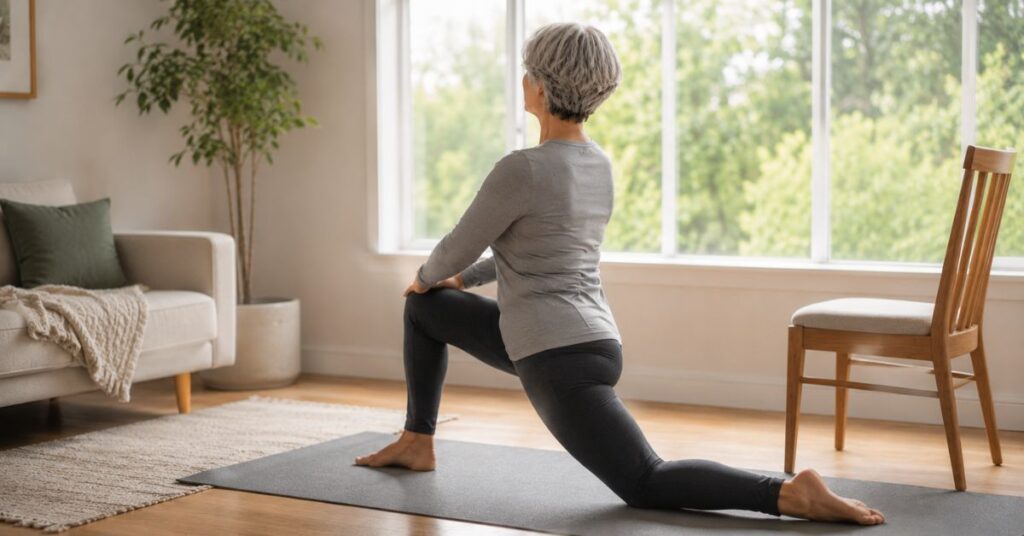
One, open what is tight. That is the front of you. Your chest, the front of your shoulders, and your hip flexors, which people leave out of posture entirely. Your psoas runs from your lower spine to the top of your thigh, so when it is short from years of sitting, it changes where your pelvis sits. Your pelvis is the base your whole spine is stacked on, which is why I will have someone working on their upper back and the thing that finally moves it is a low lunge.
Two, strengthen what is weak. And I want to be specific, because this is more than back muscles. When you slouch, something else is holding you up. The chair is doing it, or your bigger, more superficial muscles take over. So the muscles whose actual job is to stabilize you switch off, and a muscle that is not being asked to work weakens from disuse. That is your deep neck flexors, the retractors in your mid back and your lower traps, the small external rotators of the shoulder, your deep core, your erector spinae, and your glutes.
A standard yoga class does not have much pulling in it, and I think that is a real gap. There are six basic functional movement patterns the body does, and pull is one of them. Yoga has some, but very few poses. So I bring more of it into class on purpose, with Cobra and Locust and Bird Dog and rows.
Three, restore your movement variability. Your brain keeps a map of the movements you make, and when you stop using one, that part of the map gets fuzzy. The movement does not disappear, but it gets harder to reach for and it starts to feel unfamiliar when you try it. So we go back and use the pathways your day left out. Rotation. Side bending. Overhead. Behind you.
What Actually Changes, and How Long It Takes
Some of this you feel the same day. Reaching overhead, opening across your chest, getting your shoulders out of that box.
I ran a yoga for posture workshop a while back and a woman named Michelle wrote to me afterward. She had a sharp pain in the front of her shoulder for over six months, and after the class, doing her yoga homework every day, she could barely feel it anymore.
But look at what she actually did. One class, and then the homework, every day. The habits that got her there do not stop, so the countering does not stop either.
There is a saying I love. The best posture is your next posture. Change positions often, move in more directions than your day asks of you, and let posture be the result of moving well rather than something you are constantly trying to hold.
P.S. Posture is one of the five pillars my new beginner program, Lifelong Yoga Foundations, is built on. It opens at the end of September, and you can join the priority interest list here. The list hears everything first.