The Exhaustion of Constantly Trying to Fix Yourself
Aging brings wisdom we wouldn’t trade… but it also brings moments that can feel frustrating, unfamiliar, and deeply personal. Movements change. Healing takes longer. The body asks for more patience than we sometimes want to give it. And in a culture that constantly encourages us to optimize, improve, and push harder, it’s easy to start relating to ourselves like a project that’s never quite finished.
But what if some of the exhaustion we feel doesn’t come only from pain or aging itself… but from the constant resistance to what is already true right now?
This post is adapted from Yoga for Longevity, my podcast where I share therapeutic yoga tools for healthy aging. I’m Mikah Horn, yoga therapist and founder of Lifelong Yoga Online, a membership designed especially for adults 50+. If you’re looking for a way to put the things you learn in this episode into practice, you can explore it free for 7 days, with gentle classes for joint health, healthy hips, posture, and more.
The Difference Between Acceptance and Giving Up
One of the hardest things to reconcile when it comes to pain, healing, and aging is this idea that we can accept where we are while still wanting things to improve.
Many people hear words like acceptance, surrender, or “let it be” and immediately think it means giving up. If I accept this pain, am I resigning myself to it? If I stop fighting my body, does that mean I stop trying to heal?
But yoga offers a very different perspective.
Acceptance is not passivity. It’s not pretending everything is fine. It’s not abandoning growth or care. Instead, it’s the practice of loosening the struggle around what is already true in this moment.
There’s a concept in yoga philosophy called Ishvara Pranidhana, often translated as surrender. In everyday life, that doesn’t mean becoming passive or careless about outcomes. It means softening the constant need to control everything.
And most of us are carrying far more gripping than we realize.
You can feel it physically… in the jaw, the shoulders, the breath. You can feel it mentally in the spiraling thoughts:
- My body shouldn’t feel this way.
- I should be stronger by now.
- Why is this movement harder than it used to be?
- Why is healing taking so long?
The challenge is not to stop caring. It’s to stop fighting reality long enough to respond to it clearly.
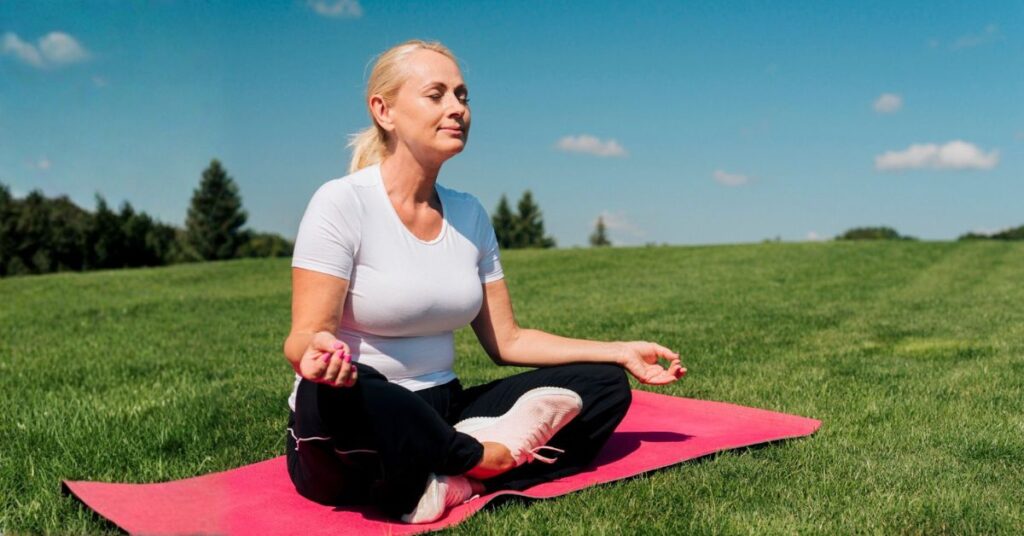
A simple practice tip: the next time you notice frustration rising during movement or exercise, pause for one slow breath before reacting. Relax your jaw. Soften your shoulders. Notice whether your body is bracing unnecessarily. Sometimes awareness alone changes the experience.
When Your Body Starts Feeling Like a Project
We live in a culture that constantly tells us to improve ourselves. Heal faster. Push harder. Stay productive. Optimize everything.
And while those messages often come from good intentions, especially around health and longevity, they can quietly turn into constant self-monitoring and self-criticism.
After a while, it’s easy to start relating to your body like it’s a problem to solve rather than a body to support.
This becomes especially exhausting when pain is persistent or when the body changes in ways we didn’t choose. Arthritis. Balance changes. Joint replacements. Fatigue. Slower recovery. The emotional weight of feeling like you “should” be further along than you are.
But healing is rarely linear.
Yoga reminds us that we can strengthen and support the body we have today without punishing ourselves for not being somewhere else already.
That shift matters.
Because when we approach the body with constant frustration, the nervous system often stays in a state of tension and vigilance. The body braces. The breath shortens. Pain can feel even louder.
But when we approach ourselves with a little more patience and compassion, we create space for clearer choices and steadier healing.
Sometimes that looks like modifying a pose instead of forcing it. Sometimes it means resting before exhaustion sets in. Sometimes it means celebrating consistency over intensity.
Gentle does not mean ineffective. In many cases, gentle is exactly what allows healing to happen.

Practicing “Let It Be” in Everyday Life
During a recent retreat in Costa Rica, I was reminded how much energy we spend trying to control everything… schedules, plans, healing timelines, outcomes, even the way our bodies are “supposed” to feel.
And yet life keeps unfolding in its own way.
There were beautiful moments on the retreat… ocean air, meaningful conversations, movement, rest, incredible food. But there were also long travel days, fatigue, unexpected stress, and even a medical emergency during the first day.
It was a real-life reminder that peace doesn’t come from controlling every variable. Often, it comes from loosening our grip just enough to meet life as it is.
Most of us can’t escape to the jungle every time we need perspective. But we can create small moments of space in everyday life.
That might look like:
- Getting outside for a short walk
- Moving your body in ways that feel nourishing instead of punishing
- Taking a few quiet breaths before reacting
- Giving yourself more spaciousness in the day
- Noticing when you’re gripping physically or emotionally
These small moments matter more than we think.
Yoga gives us “practice reps” for this over and over again. Every time we soften unnecessary tension, every time we choose awareness instead of panic, every time we pause instead of forcing… we are practicing a different relationship with ourselves.
Not perfection. Just presence.

Bringing It All Together
“Let it be” doesn’t mean giving up on healing, growth, or caring for yourself.
It means loosening the grip enough to meet yourself, your body, and your life with a little more clarity and a little less struggle.
The body changes. Healing unfolds imperfectly. Life rarely goes according to plan. But we don’t have to fight ourselves through every part of it.
Consistency over intensity. Compassion over punishment. Awareness over constant fixing.
That’s a practice worth returning to again and again.
If you’re looking for gentle, therapeutic yoga practices that support healthy aging, joint health, balance, and strength, you can try Lifelong Yoga Online free for 7 days.
Until next time, keep moving with intention and joy.
Connect with Mikah
Try 7 Days Free in Lifelong Yoga Online
Work with Mikah 1:1: Private Yoga Therapy
Instagram: @lifelong.yoga
Facebook: Lifelong Yoga with Mikah