The 5 Koshas: How Yoga Supports the Whole You

A lot of people come to yoga for exercise, or something physical. To stretch tight muscles. To improve balance. To feel a little less achy in the morning.
Those are all great reasons to start. But they’re only part of the picture.
Yoga isn’t just exercise, and it’s not just the poses. It’s a system. A system that works because you are not just your body.
What you do with your body influences how you feel in your mind and emotions. How you breathe changes your energy. Your thoughts can shape how your body holds itself.
Everything is connected. And when one part of you is off, the rest feels it.
One of the clearest ways to understand this connection is through something called the kosha model. It’s a framework that shows the different layers of your being, and how supporting one layer supports them all.
This post is adapted from Yoga for Longevity, my podcast where I share therapeutic yoga tools for healthy aging. I’m Mikah Horn, yoga therapist and founder of Lifelong Yoga Online, a membership designed especially for adults 50+. If you’re looking for a structured, joint-friendly way to put this into practice, you can explore it free for 7 days, with gentle classes for joint health, healthy hips, posture, and more.
🎧 Listen to the full episode here:
What Are the Koshas?
The koshas come from an ancient yogic text called the Taittiriya Upanishad. They describe five layers or “sheaths” of the human being.
Think of them as lenses that help us see the whole person. Some are very tangible, like muscles and bones. Others are more subtle, like wisdom or connection. Each one influences the others.
The kosha model is not mystical or abstract. It’s actually very similar to the biopsychosocial approach used in modern healthcare. Where medicine often focuses on the broken part… the aching knee, the sleepless night… the koshas help us ask, “What else is connected here?”
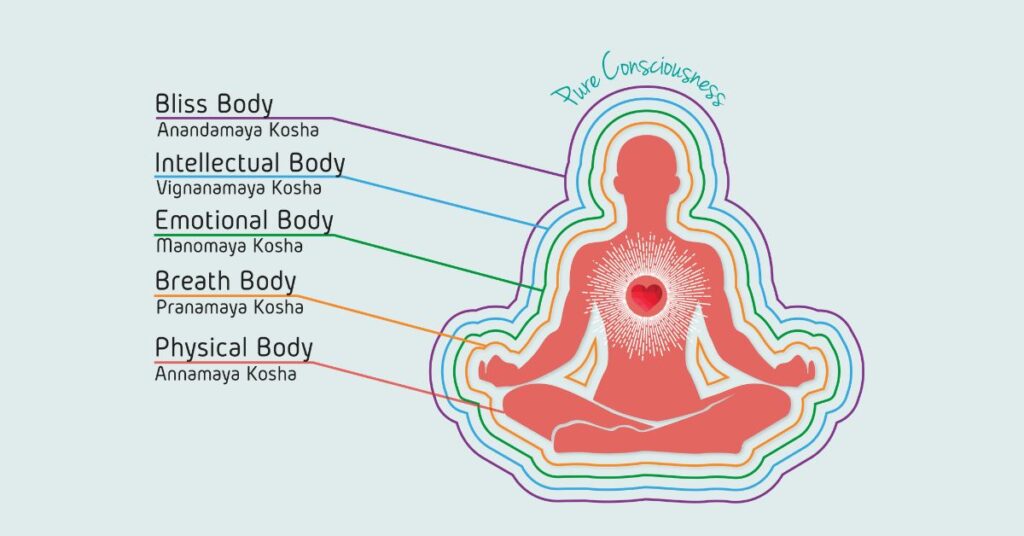
1. Annamaya Kosha – The Physical Body
This is the outermost layer, your muscles, joints, bones, and tissues.
It’s often the first place we notice discomfort. A stiff back in the morning. A knee that feels unsteady on stairs. A shoulder that aches at the computer.
Yoga works here through postures that build strength, balance, and mobility. The goal isn’t fancy poses. It’s moving through life with more steadiness and less strain. When your body feels supported, it sets the foundation for the other layers to come into balance.
Inside my membership, Lifelong Yoga Online, we often begin here with short, therapeutic practices that ease stiffness and build functional strength. But the benefits don’t stop at the body. Students often notice their breath, posture, and even energy shifting as well.
2. Pranamaya Kosha – Breath and Energy
This is the layer of life force. In everyday language, it’s your breath and the way energy moves through your system.
Most of us breathe in a way that reflects our state of mind. Shallow and quick when stressed. Deep and slow when calm.
By practicing intentional breathing, you can influence your nervous system directly. Something as simple as lengthening your exhale can lower stress and bring a sense of steadiness.
In yoga therapy, I might guide a student to coordinate breath with movement, or pause to notice how different breathing patterns change the way their body feels. Many people are surprised at how powerful this layer can be.
3. Manomaya Kosha – Mind and Emotions
This layer holds your thoughts, emotions, and habits. It’s the voice in your head that plans, worries, or replays conversations.
These patterns don’t stay “in your head.” Stress might show up as a tight jaw or shallow breathing. Sadness might round your posture. Anxiety might keep your chest lifted and tense.
Yoga offers tools like mindfulness and meditation to notice these patterns earlier. When you catch them, you have a chance to respond differently. This is where yoga begins to shift from exercise to awareness.
4. Vijnanamaya Kosha – Inner Wisdom and Discernment
This is the deeper layer of insight. It’s the part of you that chooses wisely instead of reacting on autopilot.
Here you might pause before pushing through a painful movement. Or choose rest when you recognize it will serve you better than another round of activity.
Yoga gives us practice in this discernment. Each time you notice how a pose feels, each time you choose breath over tension, you’re strengthening this kosha. Over time, it shapes how you move through your whole life, not just your practice.
5. Anandamaya Kosha – Wholeness and Connection
The innermost layer. Sometimes described as the “bliss sheath,” but not in a constant state of euphoria.
It’s the quiet feeling of being at home in yourself. The small exhale of relief after practice. The walk outside where, for a moment, everything feels steady and okay.
This layer isn’t forced. It arises when the others are supported. And even brief moments of connection here can feel deeply nourishing.
When Stretching Isn’t the Whole Story
One of my students came to me with stubborn neck and shoulder tension. She assumed she just needed more stretching.
What we uncovered was a pattern of chest breathing… lifting her shoulders with every inhale throughout her stressful workday at the computer.
Together we worked on slower, lower breathing, expanding into the ribs instead of the upper chest. We added simple mindfulness breaks, even just two minutes between meetings.
Her shoulders began to soften. Not because we “fixed” the muscles, but because we supported her whole system.
This is exactly how I approach yoga therapy…not by focusing on a single muscle or symptom, but by looking at the whole person and how each layer is connected.
What This Work Has Taught Me
Before I found yoga, I spent most of my time living in my head. I was always productive, always planning, always doing. But I wasn’t paying much attention to how I actually felt.
Yoga gave me a way back into my body. First through movement, then through breath, and eventually through quiet moments of stillness.
I started noticing tension I’d ignored, emotions I’d brushed aside, even energy levels I hadn’t paid attention to. The more I noticed, the more I began making different choices. Not because someone told me to, but because something inside me said, “This feels right.”
That’s the kosha model at work. Shifting from disconnection in the physical and mental layers toward deeper awareness and trust. And it’s still a practice I return to every day.
A Reflection for You
As you read about these layers, did one stand out? Maybe you’re noticing where your stress shows up in your body. Or realizing your breath feels different when you’re calm compared to when you’re rushed.
You don’t need to analyze or fix anything. Just noticing is the first step.
And if your yoga practice is mostly physical right now, that’s more than enough. Every layer influences the others. With time, the picture grows fuller.
Yoga supports the whole of you… body, breath, mind, and beyond.
Explore This in Your Own Practice
If you’d like support exploring these layers in a safe and structured way, you’re invited to try Lifelong Yoga Online with a free 7-day trial.
It’s my online membership designed especially for adults over 45. Inside, you’ll find:
- Gentle, therapeutic yoga classes that reduce stiffness and build strength
- Short series on posture, balance, and healthy hips
- A library of on-demand practices you can do anytime, at your own pace
- A supportive community that makes it easier to stay consistent
It’s not about doing more. It’s about moving in ways that support your whole self.
👉 Start your free 7-day trial here.
Connect with Mikah
- Membership: Lifelong Yoga Online
- Work with Mikah 1:1: Private Yoga Therapy
- YouTube: @yogawithmikah
- Instagram: @lifelong.yoga
- Free Resources: Your Yoga Toolkit | 3-Day Posture Series | Healthy Hips Guide