Yoga for Osteoporosis: Is It Safe? Is It Beneficial?
One in two. That’s how many women over 50 in this country will break a bone because of osteoporosis at some point in their lifetime. Half. And on top of that, more than half of women over 50 already have low bone mass, what we call osteopenia, and a lot of them don’t even know it. The CDC has the data. The Bone Health and Osteoporosis Foundation has the data.
So if you’re over 50 and you’ve never had a DEXA scan, please go get one.
This post is adapted from Yoga for Longevity, my podcast where I share therapeutic yoga tools for healthy aging. I’m Mikah Horn, yoga therapist and founder of Lifelong Yoga Online, a membership designed especially for adults 50+. If you’re looking for a way to put the things you learn in this episode into practice, you can explore it free for 7 days, with gentle classes for joint health, healthy hips, posture, and more.
I’ve been thinking about this number a lot lately, partly because I’ve been working on something I’ll tell you about in a minute, and partly because of a conversation I had with one of my students a few months ago.
She came to me directly. She’d just gotten her DEXA results back. Osteoporosis. And she asked if I would make her some videos, just for her, specifically for people with bones like hers, and she offered to pay me to do it. I told her no.
Not because I didn’t want to help her. Because I knew she wasn’t the only one. I have a bunch of students, both in my online membership and in my private sessions, who have osteoporosis or osteopenia. Most of them got the diagnosis recently. Most of them are trying to figure out what’s still okay to do and what isn’t. Most of them are scared in a way they don’t always say out loud.
So I told her I’d make something bigger. Something that wouldn’t just be for her, but for all of them. Honestly, this had been on my mind for a while. The conversation with her was just the moment it clicked.
I’ll come back to that.
For now, I want to talk through the two questions I hear over and over from students after a diagnosis. They’re the two questions you’re probably asking too, if you’ve recently been told your bones aren’t as strong as you thought they were.
Is yoga still safe? And is it actually doing anything for me?
The short answer to the first one is yes, yoga can absolutely be safe for someone with osteoporosis. The longer answer is that it depends on how it’s taught and how you practice it. A 2022 review in Best Practice and Research looked at the exercise advice typically given to people with osteoporosis and found that a lot of it is fear-based. Don’t bend. Don’t twist. Don’t lift anything over five pounds. And the result, predictably, is that a lot of women come out of their doctor’s office thinking the safest thing is to do nothing.
Which is actually one of the worst things you can do. Because if you stop moving, you lose strength. You lose balance. You lose mobility. You lose the things that actually protect you from a fall, which is what causes most fractures in the first place.
So the question isn’t really, is yoga safe? The question is, is this yoga, taught by this teacher, in this way, safe for my body? And I’ll be honest with you. Most yoga teachers haven’t been specifically trained in bone safety. It’s not their fault. It’s just not part of most standard teacher trainings. Which means walking into a class and saying “I have osteoporosis” doesn’t guarantee anyone will know what to actually modify for you.
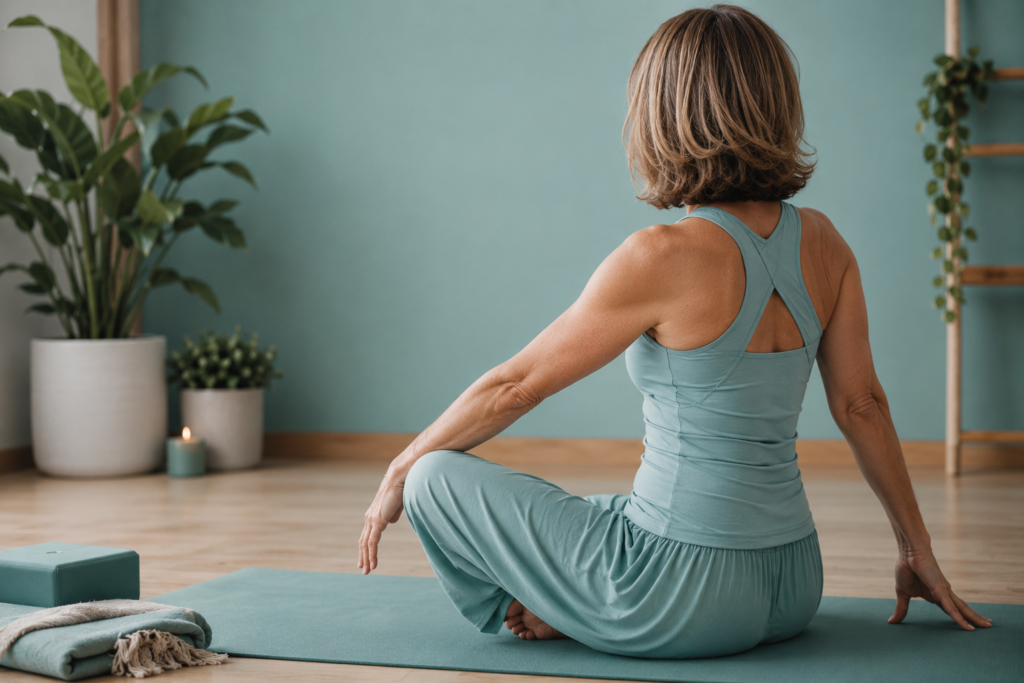
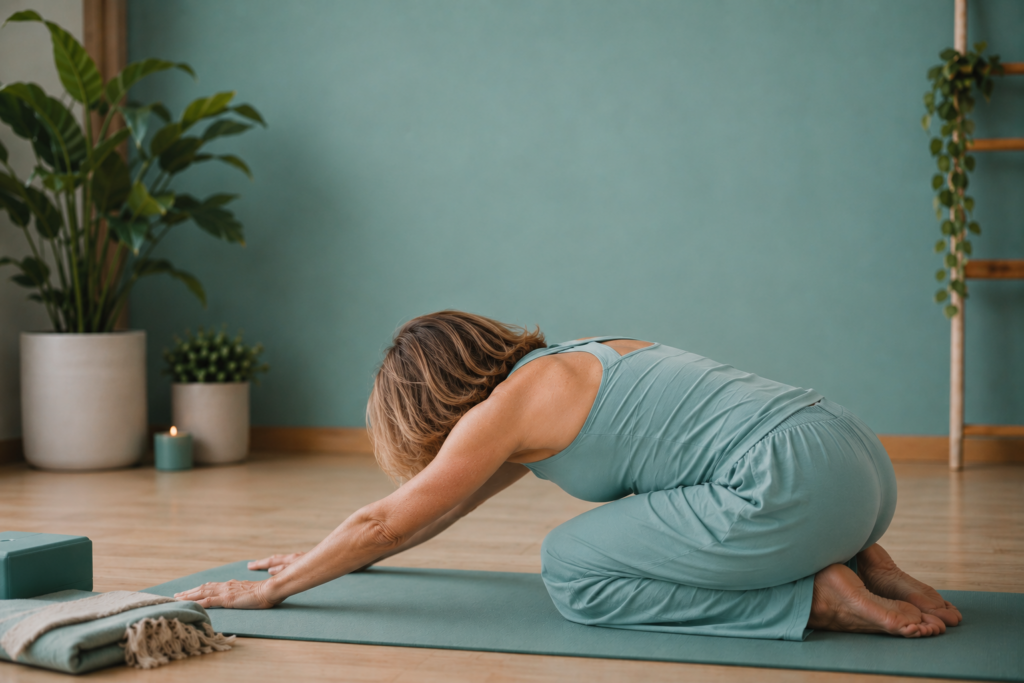
There are certain things you do want to be cautious with. Deep forward folds that round the spine heavily. Loaded twists. Repetitive crunching of the spine. Some side bends, if they involve a collapse rather than a true lengthening through the side body. These can put pressure on vertebrae that are more vulnerable to compression fractures. And spinal compression fractures are the central clinical concern when we’re talking about bones and yoga. (If you want to go deeper on that, I covered hyperkyphosis and compression fractures in Episode 43 of the podcast, and I’d send you back to that one.)
But the answer isn’t to stop moving. The answer is to learn how to move in a way that works with your bones instead of against them.
Now for the second question. Is yoga actually beneficial for those with osteoporosis?
I want to be really honest with you here, because there’s a lot of marketing in the yoga world that I don’t love. You may have heard the claim that yoga builds bone density. There is some research on this, most notably Dr. Loren Fishman’s 12-year study, where participants did 12 specific yoga poses daily and his data showed bone density improvements in the spine and hips. His work is meaningful. I respect what he’s done.
But I also want to tell you that this research is contested. It’s a smaller study. The methodology has been questioned. And the broader research on whether yoga specifically builds bone density is mixed.
So I’m not going to promise you that yoga will rebuild your bones. That’s not a claim I can honestly make.
What I can tell you is what yoga, taught well, actually does for someone with osteoporosis. Three things. And these are the things I think matter most.
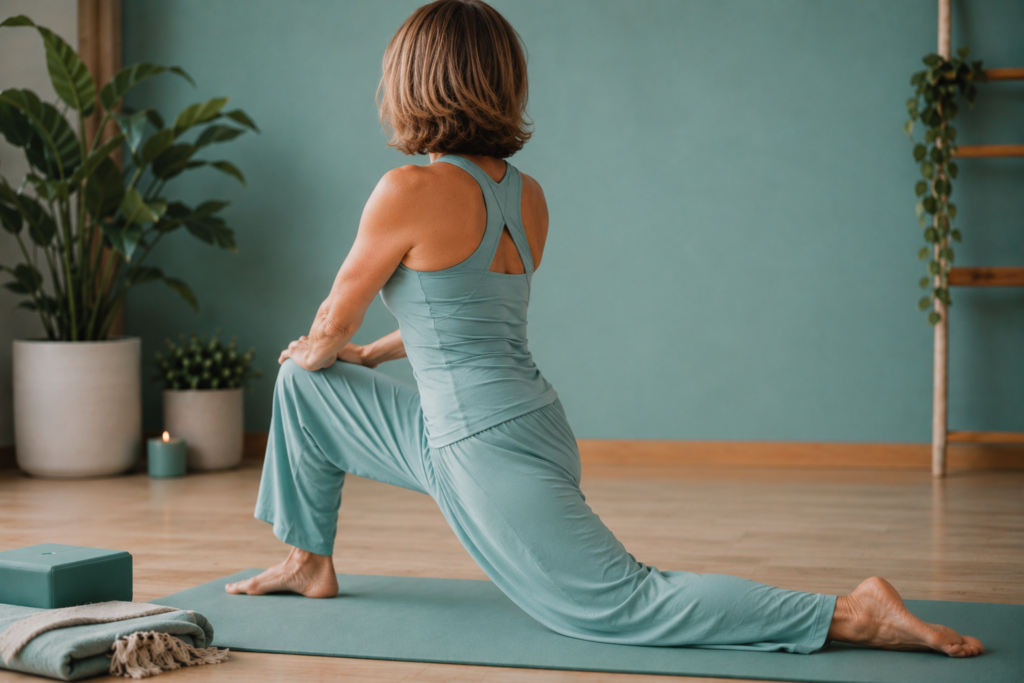
First, posture. Most of us spend our days in a forward-rounded position, and over time, the front of the body gets tight while the muscles along the back get long and weak. That rounded posture is one of the biggest contributors to spinal compression fractures over time. Yoga opens up the tight areas in the front and strengthens the muscles along the back, and that combination is what actually undoes the rounding. Not by reminding yourself to stand up straight all day, but by changing the muscular pattern underneath.
Second, balance. Falls cause most fractures. Better balance means fewer falls means fewer fractures. Yoga is one of the best balance practices I know.
Third, body awareness. This one is harder to measure, but I think it might be the most important. Because most people with osteoporosis aren’t going to fracture a vertebra in a yoga class. They’re going to fracture it doing something completely ordinary. The protection is in how you move through your whole day, and yoga is what trains that.
Those three things are incredibly important for someone with osteoporosis. Not as a replacement for whatever else you’re doing for your bones, but as a foundational part of the picture.
Which brings me back to the course I’m working on.
The conversation with my student was the moment I knew I had to actually build this. But the bigger reason is what I’ve been watching for years. My students with osteoporosis don’t have a clear bridge. They have my regular classes, which I teach in what I call a bone-mindful way, but those classes aren’t specifically designed for someone with diagnosed osteoporosis. So I still include some movements occasionally that a student with osteoporosis would want to modify or be cautious with.
What’s been missing is the specific education. Knowing exactly what to modify, why, and how to make that adaptation second nature. Not a checklist you reach for every time you step on the mat. A way of moving that just becomes part of you.
That’s what I’m building. A bridge.
So if you’ve recently been diagnosed with osteoporosis or osteopenia, this is for you: It’s called Strong Bones, Safe Yoga, and it’s a mini-course designed specifically for women who want to learn how to practice yoga safely after a diagnosis, and get the full benefit from it.
I’m officially launching it at the end of June, but the priority list is open now. Joining means you’ll be the first to know when it’s available (and you’ll get the best pricing the course will ever have).
I’ll see you inside!
Until next time, keep moving with intention and joy.